The Former and the Latter
A Gentleman in MoscowThe Former and the Latter is Count Alexander Ilyich Rostov’s name for two rival possibilities facing Moscow: a city open to the world, or one sealed against it. The distinction begins as a political forecast about the uncertain succession after Joseph Stalin, but expands into an argument about culture, geography, and the possibility of choosing how to live. The Count treats openness as a human necessity; Anna Urbanova insists that hope cannot make Russia’s inward-looking realities disappear.
A forecast about Moscow’s gates
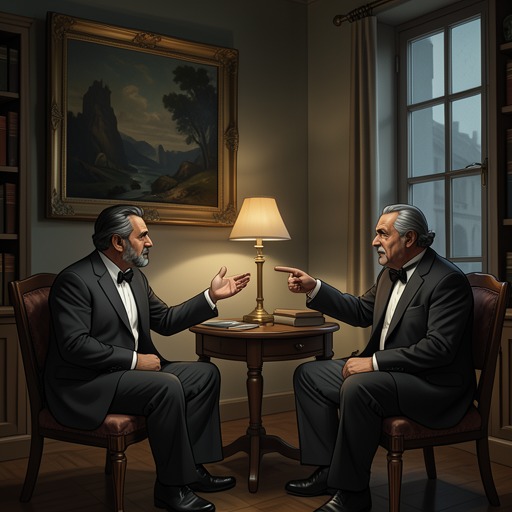
The terms arise during a conversation with Richard Vanderwhile, who warns that Joseph Stalin is gravely ill and that the city’s future will depend on who takes power. Moscow’s doors might be thrown open to the world or shut and bolted from within. The Count hopes for the first possibility. Richard, who is to lead a Paris-based intelligence research group, explains that he is seeking local friends able to provide information. He presents the request not as spying but as cosmopolitan gossip about who attends a dance, who is excluded, and who becomes angry. The exchange makes the political distinction practical: openness is not an abstraction when outside observers are trying to understand what happens inside the city.
The Count refuses to provide information about his country, telling Richard that he is no more inclined to gossip than to spy. Yet his refusal does not extinguish his interest in the future Richard has described. The contrast between the Former and the Latter gives that uncertainty a language: one possibility permits contact across borders; the other forecloses it. In the scene that follows, the Count returns to the question in conversation with Anna, turning a forecast into a more searching defense of the human desire for exchange.
The Count’s case for openness
The Count acknowledges that expecting the Former may be quixotic, but argues that even a remote possibility of openness makes surrender to the Latter unacceptable. In his view, people will keep seeking glimpses of another way of life, and sharing glimpses of their own, even when political barriers have been firmly shut. His argument rests not on a promise that borders will open, but on the persistence of the impulse to reach beyond them. The very possibility of contact gives resistance to closure its point.
He supports the claim with examples drawn from ordinary cultural life. Americans travel to Moscow to attend a performance at the Bolshoi Theatre, while the small trio at the Shalyapin tries American music heard on the radio. Emile Zhukovsky’s cooking also crosses national boundaries: his dishes draw on Vienna, Paris, and the south of France rather than adhering to a single national menu. These examples make the Former visible in exchanges that are modest as well as international. A performance, a borrowed musical idiom, or a meal can carry the presence of elsewhere into a city that might otherwise seem closed.
The Count extends the case through music. When Viktor Stepanovich Skadovsky and Sofia Rostova sit at the piano, their repertoire includes Bach, Beethoven, Rossini, and Puccini alongside the Russian composer Mussorgsky. Meanwhile, audiences at Carnegie Hall applaud Vladimir Horowitz performing Tchaikovsky. For the Count, these reciprocal acts resist the idea that culture must remain within national borders: Russian music travels abroad, and European music is played in Moscow. The Former names not simply Western influence, but traffic in both directions.
Anna’s counterargument
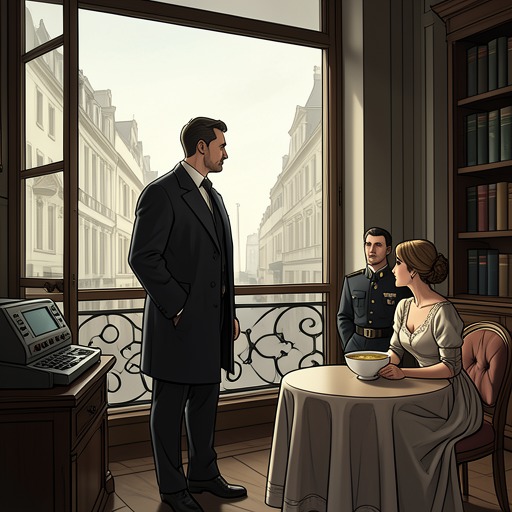
Anna does not dismiss the appeal of openness, but challenges the Count’s confidence that a person can simply live according to it. Political and geographic circumstances, she argues, must be faced wherever one lives; in Russia, facing them may require some accommodation with the Latter. Her correction is concrete. The Count’s examples come from Marseille and New York, port cities connected to the sea, and she adds Shanghai and Rotterdam as comparable cases. Moscow, by contrast, stands far from the coast, at the center of Russian culture and political life.
Anna makes the Kremlin her counter-image to the open port. Its walls, she says, are no longer high enough to repel an attack, yet they still cast a shadow across the country. The image separates physical vulnerability from enduring political influence: a wall need not be an effective fortification to remain a powerful presence. In Anna’s account, the Latter is therefore not only a policy that could be reversed by a new leader. It is also a historical and psychological force that shapes the country from its center.
She sharpens the disagreement by contrasting Moscow with America. Americans, she observes, do not appear to live in expectation that New York’s gates may be opened or closed; the Former seems foundational there, while the Latter is almost unimaginable. When the Count suggests that she sounds as though she dreams of living in America, Anna answers that everyone dreams of living there. The exchange gives her position a personal edge without reducing it to a simple wish to leave: the appeal of openness is real, but it does not by itself resolve the conditions of life in Russia.
Political uncertainty and the limits of the distinction
The surrounding political account bears out the uncertainty behind the Count’s terms. After Stalin’s death, no succession plan or uncontested heir is in place. Several senior figures have plausible claims, and the leadership arrangement changes rapidly: Georgy Malenkov initially appears likely to prevail, but the Party’s upper ranks reject the concentration of two leading posts in one person and require him to pass the Secretariat chairmanship to Nikita Khrushchev. The result is a fragile balance between antagonists, leaving the direction of the country unsettled. The Former and the Latter name possibilities rather than guaranteed outcomes.
The novel places this debate alongside scenes in which large systems turn complex life into plans, procedures, and records. The First Five-Year Plan demands increased agricultural production to feed the cities; the campaign to remove kulaks, resistance to agricultural innovation, scarce tractors, poor weather, and rising requisitions at gunpoint compound the pressure on the countryside. In the Boyarsky, meanwhile, a new ordering procedure routes each meal through a waiter’s pad, a bookkeeper’s ledger, kitchen logs, and stamped slips. These episodes do not explicitly identify themselves with either term, but their juxtaposition with the Count’s argument gives the distinction a wider resonance: political and administrative systems can impose a single direction, while lived culture and individual practice remain more varied than the plan allows.
The terms are thus both an argument and a measure of its incompleteness. The Count sees cultural exchange as evidence that the Former persists even under constraint; Anna insists that geography, history, and power prevent hope from serving as a complete account of Russian life. Neither position cancels the other. Their exchange leaves the distinction alive as a tension between the desire to open doors and the forces that keep casting a shadow over them.